
OAL News

Time to act: robotics in food and beverage manufacturing

APRIL™ Robot Chef
Food manufacturing is facing a perfect storm driven by the living wage; flat line productivity and food deflation. Advanced technology and robotics can address these issues yet the UK is seriously lagging behind the developed world in its implementation. The Office of National Statistics recently announced that the UK has returned to recession for the 3rd time in 8 years. A dive in productivity further underlines the challenge in the UK manufacturing sector. The UK now has a 30% lower GDP per hour than countries such as the US, France and Germany. It must be time for food and drink, the largest manufacturing sector in the UK, to act.
The impact of robotics
In 2014, global robot sales increased by 29% to 229,261 units with the main growth seen in the automotive industry, representing 40% of all robots sold. The UK food and drink sector has a 10-year average adoption rate of just 63 robots a year!
China has expanded its leading position in the adoption of robotics with 25% of the total supply in 2014. High productivity countries such as Germany, France and US show a strong correlation to the number of robotic installations, with the US and Germany featuring in the five countries accounting for 70% of all robot sales along with China, Japan and Korea. France also increased investment in robotics, while the UK’s commitment has been in decline. The forecast for robotic installations sees China looking to around 150,000 by 2018, double the 2014 levels, compared to the UK whose outlook is relatively flat during the same period. The other industrial nations have shown steady growth during the same period.
With the food and beverage sector at such low levels of commitment and as such an important economic contributor, the use of robotics must become part of the vision for the future food factory, and the move to Food Manufacturing 4.0.
Barclay’s bank (2015) forecasts that an investment of £1.2bn in automation will add £60bn to the UK economy, ultimately safeguarding 106,000 jobs. Barclays note that the food and drink sector would be one of the primary sectors to benefit, with productivity improvements of 25% being achieved by 2025. Early indications are proving that embracing automation has enhanced productivity and lead to job creation.
Global centre of excellence for robotic food manufacturing
Working with the University of Lincoln we have been championing Food Manufacturing 4.0 and have developed the transformative APRIL™ Robot Chef. APRIL is challenging the way food production lines are set out, moving away from ‘traditional’ linear continuous production, where high volume and limited flexibility have been the watchwords. APRIL will deliver a system that introduces a return to flexible batch systems, but with intelligent and integrated scheduling that optimises production, improves efficiency and in doing so enhances productivity – Potentially more traditional than continuous linear systems in reality?
At the successful launch of the APRIL Robot Chef in April, we set out our vision to create a Global Centre of Excellence for Robotic Food Manufacturing at the University of Lincoln to:
Educate the industry.
Partner with visionary early adopters.
Deliver disruptive change in manufacturing.
If you’re interested in transforming your facility and bucking the productivity trend, get in touch with our experts!
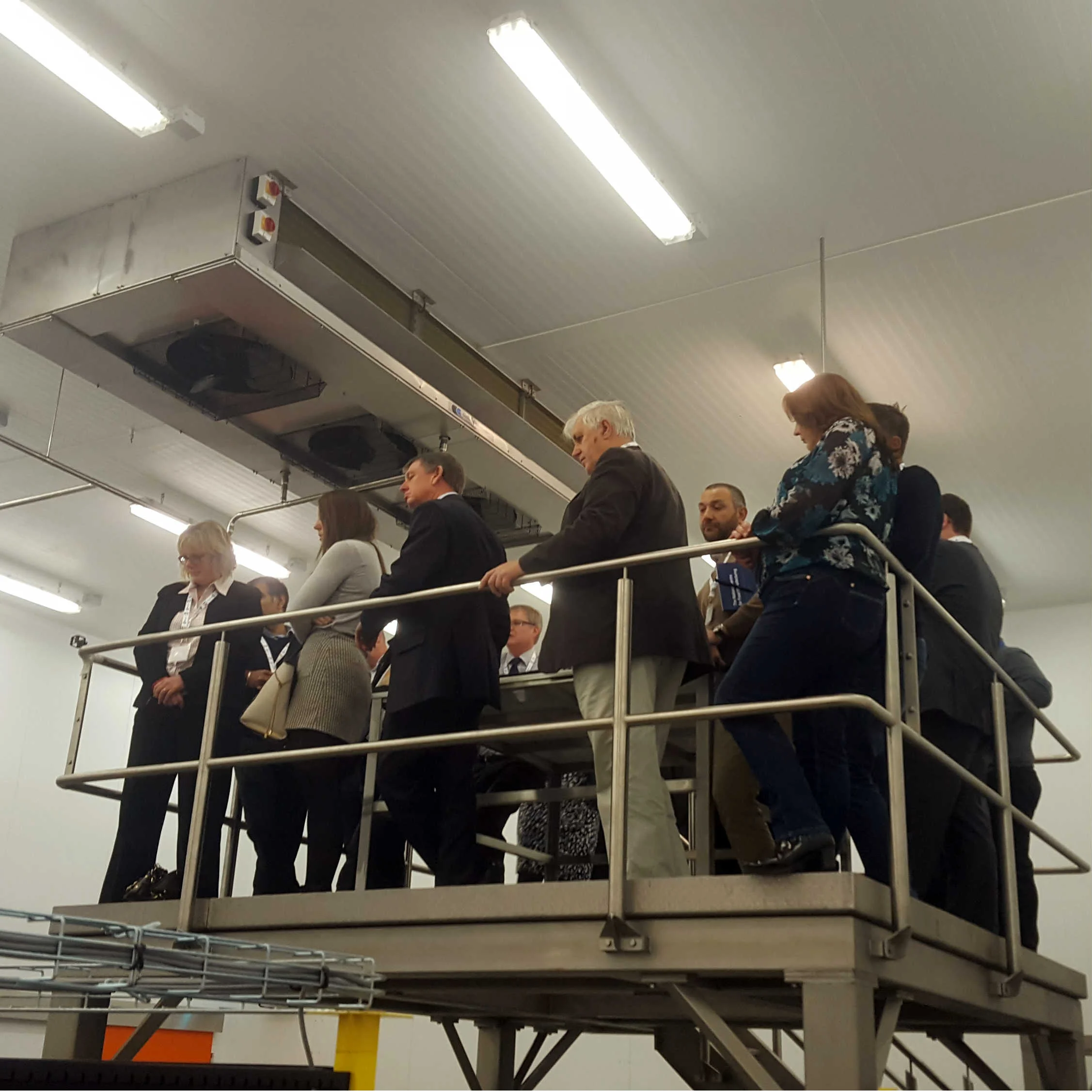
Successful APRIL™ Robot Chef launch & slides

We launched APRIL™ the Robot Chef at the National Centre for Food Manufacturing during a conference with the University of Lincoln focused on understanding how robotics and automation will change food processing. Food manufacturing is facing a perfect storm driven by the living wage; flat lining productivity and food deflation. Advanced technology and robotics can address these issues yet the UK is seriously lagging behind the developed world in its implementation. Speakers discussed different aspects of this challenge which culminated in live demonstrations of the APRIL™ Robot Chef system in our state-of-the-art test centre.
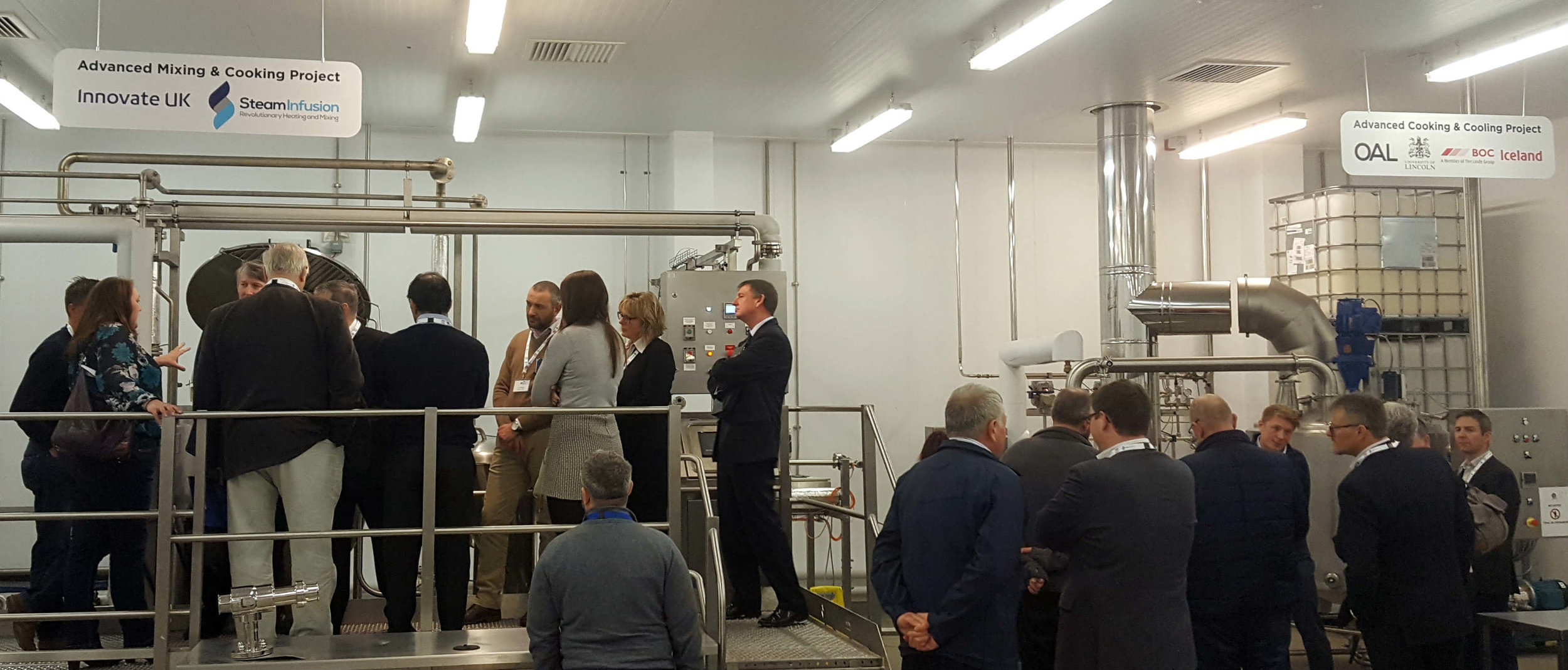
Food professionals view Steam Infusion & cryogenic cooling
Moving forward, our vision is to create a Global Centre of Excellence for Robotic Food Manufacturing at the University of Lincoln that will:
Educate the industry
Partner with visionary early adopters
Deliver disruptive change in manufacturing.
The APRIL™ system demonstrates the potential of robotics to deliver competitive advantage for food manufacturers and how they can overcome existing challenges e.g. traceability, flexibility, adaptability, quality etc.
Speakers included:
Andrea Paoli, Senior Robotics Lecturer at the University of Lincoln explaining the basics and future of robotics.
Jeff Nowill, CEO, Kuka Robotics UK on the intersector knowledge transfer opportunities for the adoption of robots.
Ian Beauchamp, OAL's Head of Process Engineering on the challenges robotics can overcome on the shop floor.
Mark Swainson, Principal lecturer on the challenges robotics can overcome on the shop floor.
Harry Norman, OAL's Managing Director describing his vision of robotic food manufacturing.
Here are the slides from the day (they can be downloaded by clicking through to Slideshare for Jake Norman’s slides and Jeff Nowill’s slides)
Biographies of speakers:
Andrea Paoli
Andrea has been a Senior Lecturer in Industrial Automation and Robotics since 2014 at the University of Lincoln where he serves as the Programme Leader for the brand new BEng Automation Engineering programme. He is a Senior Member of IEEE and a member of the IEEE Robotics and Automation Society UK organising committee.
Jeff Nowill
Jeff is a chartered engineer; having completed an apprenticeship at Dunlop Aviation, and a degree in Mechanical Engineering at Coventry University. He joined KUKA in 2009, and is CEO of the UK and Irish operations, and sits on the board of ESPRC’s RAS network. KUKA boast a turnover in excess of €3 billion, as a world-class manufacturer of industrial robots and automation solutions.
Ian Beauchamp
Ian’s background is control engineering and business. He draws on over thirty years’ experience working for companies such as P&G and APV within R&D, design, project management together with leading product, service and engineering activities. Ian facilitated Performance Optimisation projects within the food industry in a global position utilising Six Sigma and Lean Methodologies.
Mark Swainson
Mark’s industrial background is Technical and Operations Management within the high risk chilled and frozen food industry. He is listed on the European Food Safety Authority Food Safety Experts Database, is an experienced Lead Auditor and a member of the Institute of Packaging. Mark conducts industry based research to address specific food industry challenges; Quality, Safety and Hygiene Control Systems, Advanced Process Technologies & Automation, Food Supply Chains, Microbiological Safety and Shelf Life
Harry Norman
Harry was just 28, with only a few years of industry experience and a first class degree in controls and automation when he founded OAL (Olympus Automation Ltd) in 1993. OAL now supply cutting edge food manufacturing systems for leading blue chip clients such as Allied Bakeries and Bakkavor that have increased the efficiency and consistency of their manufacturing operations.
OAL partners with Macmillan Cancer Support for 2016 fundraising

not-alone-e1361533920700

macmillan.5
In 2016 OAL will be running, cycling, baking and more to fund raise for Macmillan Cancer Support. As our official 2016 charity, we hope to assist Macmillan (made up of professionals, volunteers and campaigners) in their journey to offer support and inspiration to those affected by cancer, to take back control of their lives.
There are currently 2.5 million people living with cancer in the UK alone with that number expected to reach four million by 2030, so there is no time like the present. It costs £27 for a Macmillan nurse for an hour, that nurse could provide emotional and practical support as well as essential medical advice to those affected by cancer. Nobody should have to go through cancer alone so if you would like to join us in supporting this fantastic charity.
Find out more about our social responsibility!

OAL secures £60,000 for APRIL™ robot development
We are pleased to announce we have received a £60,000 Agri-Tech Growth Grant for the development of our robotic food processing system, APRIL™. The grant will be used to further develop APRIL™, our fully automated robotic food manufacturing cell that will boost production, efficiency and improve the quality of food produced.
“OAL is transforming the food manufacturing industry through their technology. The APRIL™ system will kick-start the industry’s move towards fully automated production lines, allowing food to be produced quicker, with less waste and greater precision.”

APRIL™ robot with food basket
A full size demonstration system is being built at the National Centre for Food Manufacturing part of the University Lincoln in Holbeach, Lincolnshire - come and learn more about the technology.

OAL sponsors Cambridgeshire Kidsafe Scheme


OAL is delighted to announce that we are a proud sponsor of Kidsafe, an organisation that actively commits to helping keep kids safe across the UK and EIRE. Unfortunately, kids’ safety is a major issue these days for everyone involved including parents and teachers. The philosophy at Kidsafe is to make children more aware of the dangers they face without destroying their sense of adventure, they believe the best approach is to make learning about safety fun.
“OAL is pleased to sponsor the Kidsafe School Safety Pack; it’s an important scheme and we like to get involved with and help local charities.”
OAL has sponsored the ‘School Safety Pack’ which is distributed to primary schools around the Cambridgeshire area, in order to educate them on the responsibility of their own safety. This pack includes a ‘Get Home Safely’ game which visually demonstrates the actions to take when faced with issues over their own safety, in a fun board game inspired layout.