
OAL News

Robotics & Food Manufacturing 4.0. Are you ready?

Whether robots really belong in a food factory is becoming a no-brainer. In order for the food industry to improve and grow, robotics and automation WILL play a major role in the food manufacturing process. Andrea Paoli reveals how robots have taken root so far in our manufacturing systems and are set to revolutionise the food industry in Food Manufacturing 4.0 and beyond.
The value of robotics
Andrea Paoli presented a number of very enlightening figures when introducing the impact robotics will have in the future. Here are a few to set the scene:
The Bank of England in November 2015 predicted that over the next decade, 15 million jobs will be taken over by robots.
In 2020, the robot market is expected to hit a value over $83 thousand million.
It’s predicted that the global saving for using robotics in terms of labour cost is 16%.
By increasing investment in automation by £1.2 billion, this could raise the overall value added by the manufacturing sector to the UK economy by £60.5 billion. This could safeguard 106,000 jobs.
Since the industrial revolution, robots have gone from mechanical production equipment driven by water and steam all the way to cyber-physical systems which integrate computers, networking and physical processes. The degree of complexity of robotics is forever increasing. As you can see from the videos in Andrea's slides, the capabilities of robotics and automation have increased and improved dramatically. Is there anything they won’t be able to do?
So what does Food Manufacturing 4.0 look like?
Robotics and automation have progressed in such a way that it’s safe for them to work in collaboration with humans (HRC systems - Human/Robot Collaborative systems). They can work to full capacity 24/7 producing the same results they’re programmed to complete. This is impossible for humans to achieve to the same degree of accuracy and consistency.
Therefore, there is a massive opportunity for an increase in productivity for food manufacturers due to the reduced cycle and turnaround times. A robot can work within stabilised conditions without human interface. Not only does this improve the health and safety of the factory, it can also increase the shelf life of products contributing to reducing waste which is a very hot topic at the moment!
Working together with the University of Lincoln, OAL has been championing Food Manufacturing 4.0 and have developed a robotic chef APRIL. APRIL is facing up to the challenges food production is facing to introduce a flexible, automated, continuous, high volume system to food manufacturers. Read more about APRIL and her talents here.
How will a future food factory look?
A factory of the future will run on big data being used intelligently to improve decision making and planning. Cloud computing will allow for anything to be controlled, recorded or reported in real-time. With humans collaboratively working together with robots along with all the big data that will be available, factories will be able to optimise production, reduce wastage and improve product consistency and quality.
Join OAL on this journey by helping us educate the industry to deliver disruptive change in manufacturing securing your factory’s future as well as the future of the food manufacturing industry.

Ann Savage on the future of chilled food manufacturing

What is the right environment for chilled food innovation? Ann Savage, former Group Technical Director at Bakkavor, spoke at the Food Manufacturing 2030 Conference on the future of chilled food over the next ten years. Discussing the rise of new technologies including robotics, Ann highlighted the pressing need for food manufacturing to create the right conditions for successful innovation. After discussing a number of the wide-ranging challenges food manufacturing faces including environmental and significant cost pressures Ann stressed the importance of creating the right conditions for innovation in the UK. Collaboration between research institutions, technology providers and manufacturers will be very important in realising new developments. Likewise, further investment is needed in skills to realise the benefits of new technologies.
Ann has seen the tremendous growth of the chilled food market which has leapt from revenues of from £5 billion in 2000 to £11.4 billion in 2014 and is still growing. Discussing the benefits and rise of automation and robotics, Ann highlighted amongst others the following areas of interest:
Longer shelf life
Robots can work within controlled environment with limited exposure to bacteria and allergens often carried by people. There are significant opportunities for improving the shelf life of products, reducing waste and improving the overall safety and hygiene of the factory in this way.
Improve decision making
Automation within a factory can also reduce human decision-making. The collection and intelligent use of big data will allow problems to be resolved before they occur, as their played out in digital factories. This will allow factories to plan further ahead, reduce stoppages and save time on resources.
Farm to fork
Improved data collection and analysis will enhance food safety from farm to fork. Big data applications will enable full visibility of the supply chain with in-line quality checks enhancing protection against errors.
If you’d like to bring these benefits into your manufacturing facility, our experts can help you take the first step.

McKinsey report: where will automation replace humans in food manufacturing

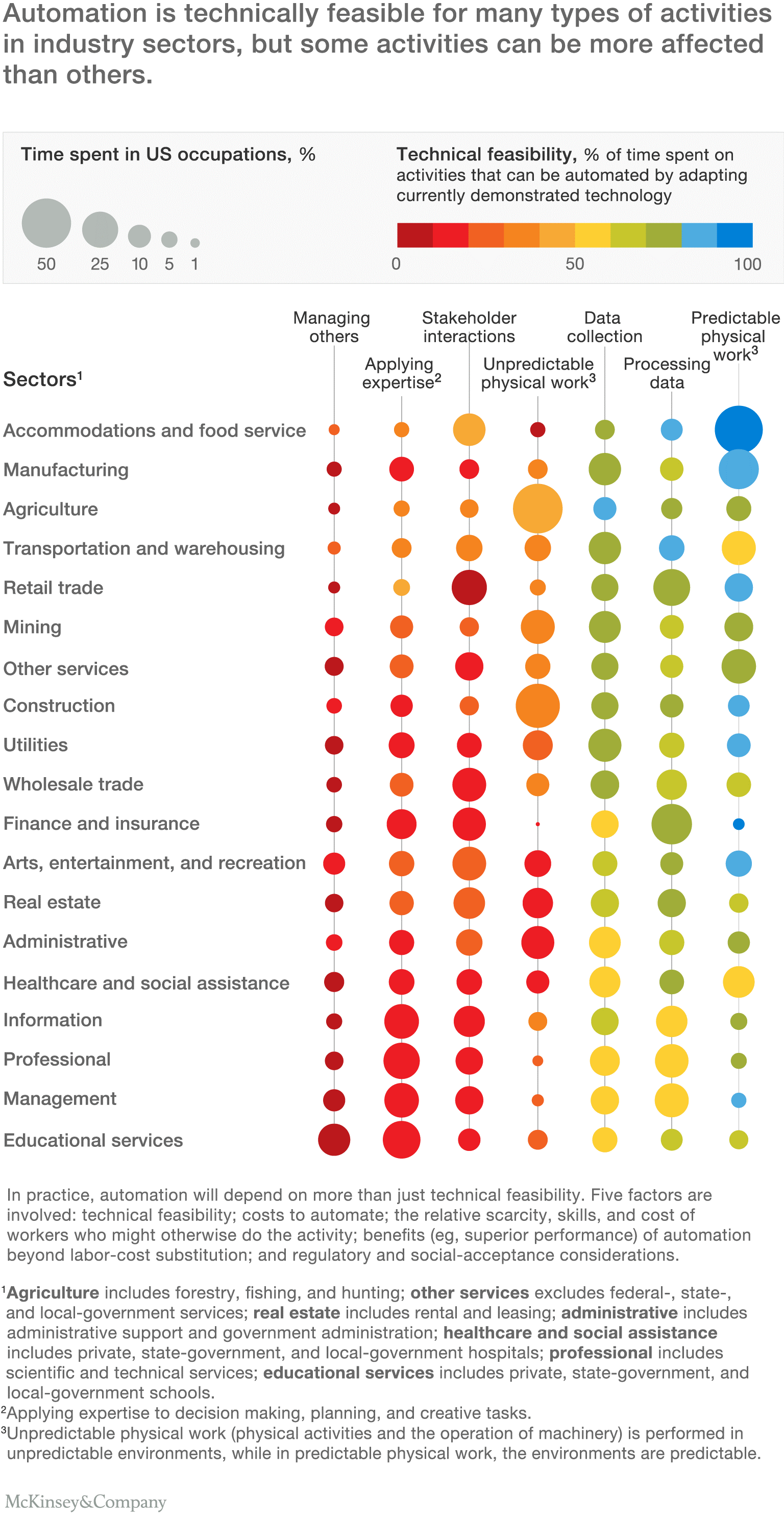
Food service and manufacturing sit at the top of a recent McKinsey report that analysed work activities rather than occupations as a predictor of automation. By identifying jobs with predictable physical work, data processing or data collecting, they were able to assess the technical feasibility of automation. By breaking down jobs by activities, up to 59% of time spent at work in the US is highly susceptible to automation. Further analysis suggested that food service and manufacturing were more suited to automation than others i.e. many activities within food manufacturing are highly susceptible to automation.
Technical feasibility of automation in food
The McKinsey report highlights food manufacturing and food service as highly susceptible to automation due to the activities involved in the jobs (see figure 1). The main driver for this is the high amount of time people spend on predictable physical work. Often in food factories, people will undertake a high number of predictable activities such as lifting product, moving ingredients etc. (see figure 2).
In our experience, the trend fits for our customers who manufacture a smaller range of SKUs and have already been able to automate a high number of the predictable activities. This is in contrast to chilled food manufacturing, where upwards of 40 SKUs can be produced per day and predictable and unpredictable activities become intertwined.
One major part of the puzzle will be splitting out the predictable from the unpredictable physical work, thus enabling higher levels of adoption of robotics. For instance, lifting ingredients into a saucepan is a predictable task but judging the taste of the food requires the expertise of a chef, hence it isn't so susceptible to automation.
We're working with the University of Lincoln to develop robotic systems that provide manufacturers the flexibility to split out the predictable from the unpredictable thus enabling greater levels of automation. APRIL™ the Robot Chef installed at the National Centre for Food Manufacturing enables this flexibility by breaking down activities in a different way to traditional manufacturing processes.

Mckinsey Technical feasibility
Mckinsey industry Feasbility
Making big data small in food manufacturing
Confused about the impact of big data on food manufacturing? We believe many food manufacturers already have the data and our focus is better directed to the meaningful presentation of figures to deliver operational improvements.
Originally featured as a guest article on www.bakeryandsnacks.com
There’s a lot of excitement about the internet of things (IoT) and big data but realistically many larger food manufacturers already have access to lots of data. When we speak with our customers, often the idea of more data is seen as a distraction. There are bigger opportunities for operational improvements in presenting data in an informative and actionable way. For big data to be a success, data must be more informative, actionable and timely.

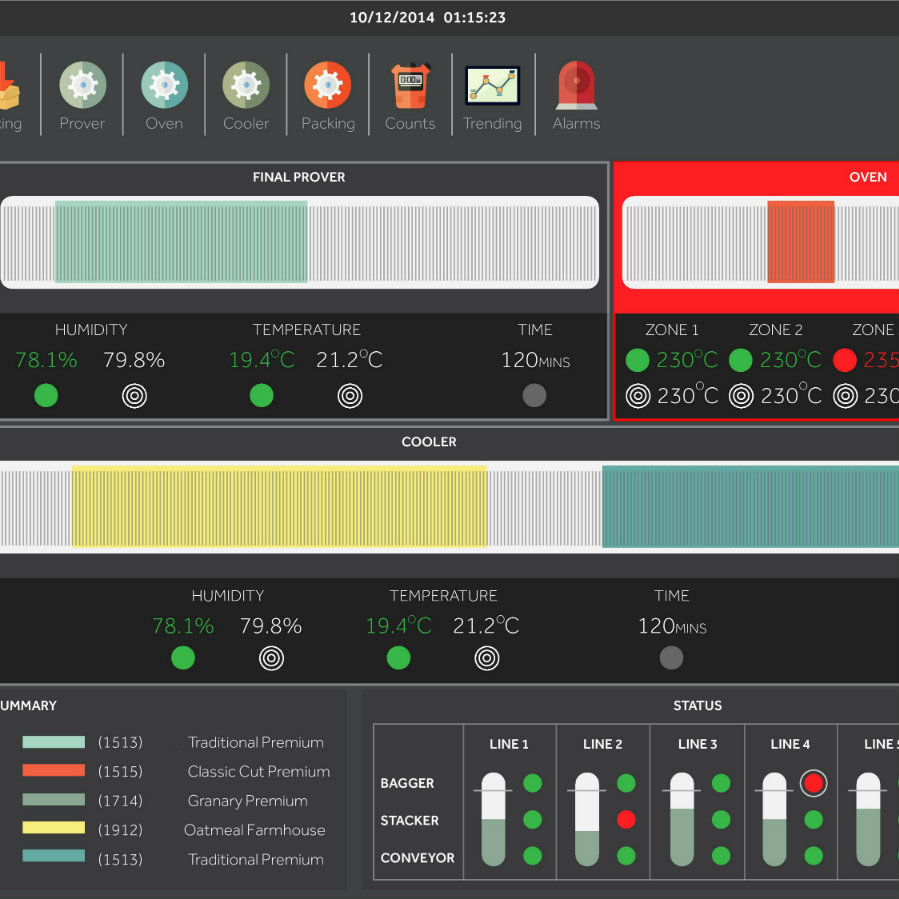
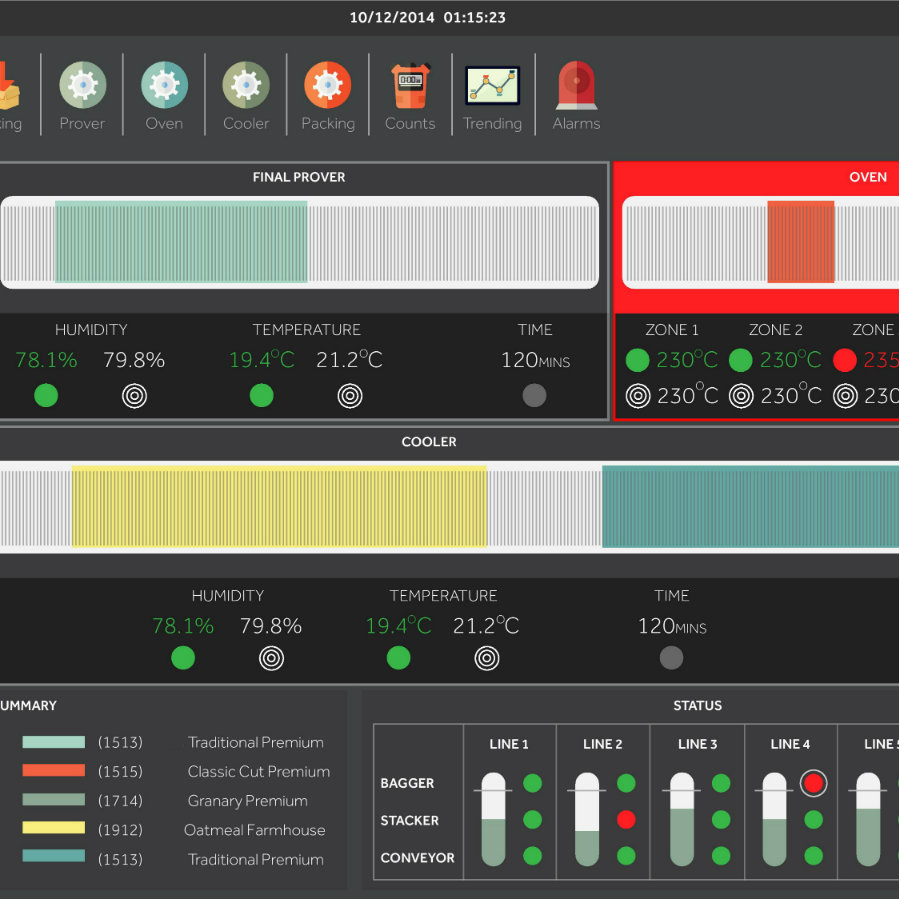
OAL big data bakery SCADA screen
Informative big data
What use is all the data about a process if it’s not easily understood by engineers and operators? One of the big switches we’ve made on our control systems is how we present data. For instance, when you compare our traditional SCADA screens to our newly developed screens they look completely different. Designed with user experience at its core, the new visuals seek to present information that is much more relevant to the end user. For a bakery process, traffic light systems easily indicate if there are any issues relating to humidity, temperature etc. If they’re all green no worries at all. Likewise representing the flow of product as blocks as opposed to how the system operates clearly indicates bottlenecks and breaks in production.
Actionable big data
Data, no matter what its size, is useful to management, engineers and decision makers when it’s actionable. We’ve brought vegetable preparation lines into the 21st century by providing individual operators a screen with real time yield, production feedback and all their Standard Operating Procedures (SOPs). Previously multiple operators would be reliant on a single beacon to track weight. Now actionable data can be presented on an individual basis to improve yield and performance. For both management and operators, it’s clear if an individual is giving away too much product and both parties have the information to hand to take action.
Timely big data
Reviewing yesterday’s production reports looking for insights leaves manufacturers in a reactive state. Manufacturing excellence requires proactive responses to data. Timely delivery of data removes distractions and allows operators and engineers to focus on the job at hand until required. Simple things like changing the colour of a screen from blue, when the downtime is planned, to red, when the downtime runs over are easily understandable.

OAL Factory Performance Changeover
Big data has the potential to be extremely powerful but only if it’s presented in a timely, informative, actionable manner to end users - take the first step today!

Time to act: robotics in food and beverage manufacturing

APRIL™ Robot Chef
Food manufacturing is facing a perfect storm driven by the living wage; flat line productivity and food deflation. Advanced technology and robotics can address these issues yet the UK is seriously lagging behind the developed world in its implementation. The Office of National Statistics recently announced that the UK has returned to recession for the 3rd time in 8 years. A dive in productivity further underlines the challenge in the UK manufacturing sector. The UK now has a 30% lower GDP per hour than countries such as the US, France and Germany. It must be time for food and drink, the largest manufacturing sector in the UK, to act.
The impact of robotics
In 2014, global robot sales increased by 29% to 229,261 units with the main growth seen in the automotive industry, representing 40% of all robots sold. The UK food and drink sector has a 10-year average adoption rate of just 63 robots a year!
China has expanded its leading position in the adoption of robotics with 25% of the total supply in 2014. High productivity countries such as Germany, France and US show a strong correlation to the number of robotic installations, with the US and Germany featuring in the five countries accounting for 70% of all robot sales along with China, Japan and Korea. France also increased investment in robotics, while the UK’s commitment has been in decline. The forecast for robotic installations sees China looking to around 150,000 by 2018, double the 2014 levels, compared to the UK whose outlook is relatively flat during the same period. The other industrial nations have shown steady growth during the same period.
With the food and beverage sector at such low levels of commitment and as such an important economic contributor, the use of robotics must become part of the vision for the future food factory, and the move to Food Manufacturing 4.0.
Barclay’s bank (2015) forecasts that an investment of £1.2bn in automation will add £60bn to the UK economy, ultimately safeguarding 106,000 jobs. Barclays note that the food and drink sector would be one of the primary sectors to benefit, with productivity improvements of 25% being achieved by 2025. Early indications are proving that embracing automation has enhanced productivity and lead to job creation.
Global centre of excellence for robotic food manufacturing
Working with the University of Lincoln we have been championing Food Manufacturing 4.0 and have developed the transformative APRIL™ Robot Chef. APRIL is challenging the way food production lines are set out, moving away from ‘traditional’ linear continuous production, where high volume and limited flexibility have been the watchwords. APRIL will deliver a system that introduces a return to flexible batch systems, but with intelligent and integrated scheduling that optimises production, improves efficiency and in doing so enhances productivity – Potentially more traditional than continuous linear systems in reality?
At the successful launch of the APRIL Robot Chef in April, we set out our vision to create a Global Centre of Excellence for Robotic Food Manufacturing at the University of Lincoln to:
Educate the industry.
Partner with visionary early adopters.
Deliver disruptive change in manufacturing.