
OAL News

Food Manufacturing 2030 Conference - APRIL to cook lunch

Get your lunch cooked by a robot and learn what food manufacturing could look like in 2030. Join us and other food industry leaders to ponder what food processing will look like when we're in driverless cars at the Food Manufacturing 2030 Conference at the National Centre for Food Manufacturing, Holbeach, UK on Thursday 13 October 2016.

See the future
The food industry is ripe for change as it faces a perfect storm driven by the living wage, flat line productivity and food deflation. We believe in order to meet these challenges the industry must transform itself with flexible robotics and automation over the next two decades.
Share in our vision of the future and join us on Thursday 13 October 2016; listen to expert speakers and watch demonstrations as we debate food manufacturing in 2030. Designed for senior food professionals, the event is FREE to attend, and we expect strong discussions as we shape the future of our industry.
APRIL will cook your lunch
Our APRIL robotic food processing platform is pushing barriers and attendees will get a taste of the future as she's cooking lunch. Watch the future of ready meal production as APRIL (Automated Processing Robotic Ingredient Loading) effortlessly twirls a pan around the food processing hall combining ingredients, cooking and cleaning with no human intervention.
Expert speakers
We've brought together thought leaders from across the food industry to provide insights into why and how the food industry will change by 2030. Speakers include:
Simon Lushey, Specialist Technical Manager at Marks & Spencer, will be speaking about why innovation is important to retailing.
Ann Savage, Technical Specialist (Former Group Technical Director at Bakkavor), will be speaking about the future of chilled food manufacturing.
Steve Osborn, Food Technology Scout, will be discussing the consumer trends that will shape food manufacturing moving towards 2030.
Andrea Paoli, Senior Lecturer in industrial automation and robotics at the University of Lincoln, will be speaking about robotic technological developments.
More expert speakers are set to be announced.
Who should attend?
The event is designed for senior food processing and industry professionals looking to learn how robotics and automation will transform their food businesses. Expected delegate job titles include:
Managing Director, Operations Director, Technical Director, Innovation Director, General Manager, Technology/Innovation Manager, NPD Manager, Continuous Improvement Manager
Making big data small in food manufacturing
Confused about the impact of big data on food manufacturing? We believe many food manufacturers already have the data and our focus is better directed to the meaningful presentation of figures to deliver operational improvements.
Originally featured as a guest article on www.bakeryandsnacks.com
There’s a lot of excitement about the internet of things (IoT) and big data but realistically many larger food manufacturers already have access to lots of data. When we speak with our customers, often the idea of more data is seen as a distraction. There are bigger opportunities for operational improvements in presenting data in an informative and actionable way. For big data to be a success, data must be more informative, actionable and timely.

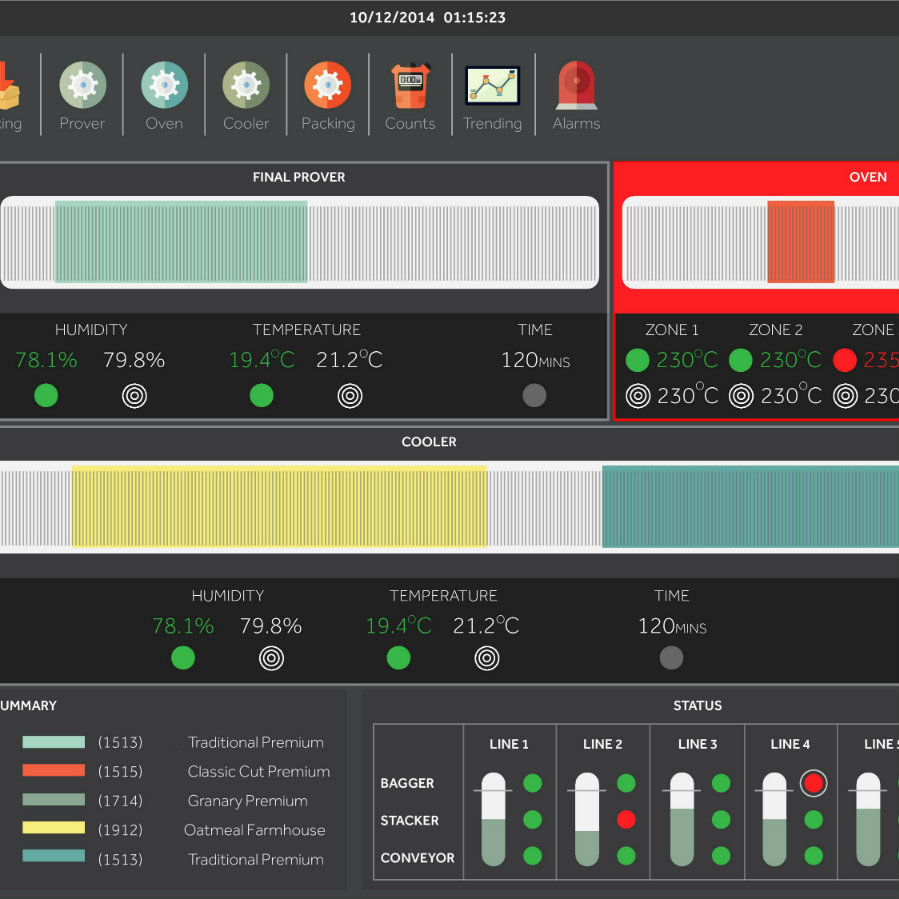
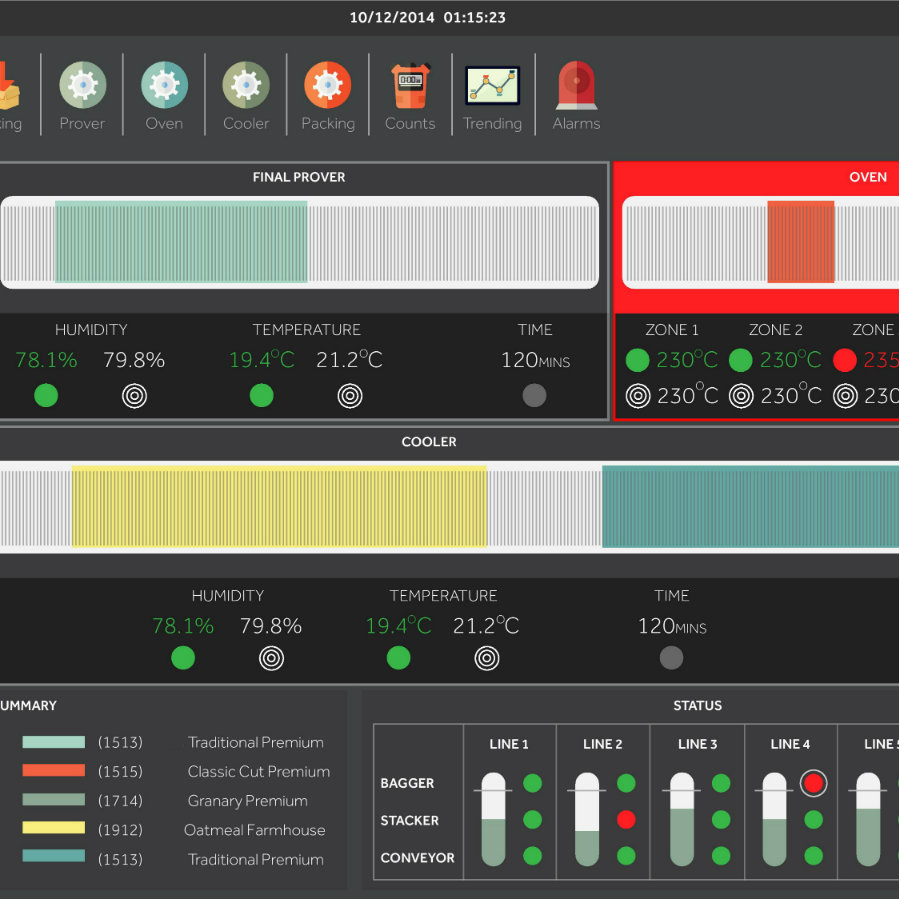
OAL big data bakery SCADA screen
Informative big data
What use is all the data about a process if it’s not easily understood by engineers and operators? One of the big switches we’ve made on our control systems is how we present data. For instance, when you compare our traditional SCADA screens to our newly developed screens they look completely different. Designed with user experience at its core, the new visuals seek to present information that is much more relevant to the end user. For a bakery process, traffic light systems easily indicate if there are any issues relating to humidity, temperature etc. If they’re all green no worries at all. Likewise representing the flow of product as blocks as opposed to how the system operates clearly indicates bottlenecks and breaks in production.
Actionable big data
Data, no matter what its size, is useful to management, engineers and decision makers when it’s actionable. We’ve brought vegetable preparation lines into the 21st century by providing individual operators a screen with real time yield, production feedback and all their Standard Operating Procedures (SOPs). Previously multiple operators would be reliant on a single beacon to track weight. Now actionable data can be presented on an individual basis to improve yield and performance. For both management and operators, it’s clear if an individual is giving away too much product and both parties have the information to hand to take action.
Timely big data
Reviewing yesterday’s production reports looking for insights leaves manufacturers in a reactive state. Manufacturing excellence requires proactive responses to data. Timely delivery of data removes distractions and allows operators and engineers to focus on the job at hand until required. Simple things like changing the colour of a screen from blue, when the downtime is planned, to red, when the downtime runs over are easily understandable.

OAL Factory Performance Changeover